
Who Stole Our Focus? The Most Valuable Human Asset in the Age of Distraction
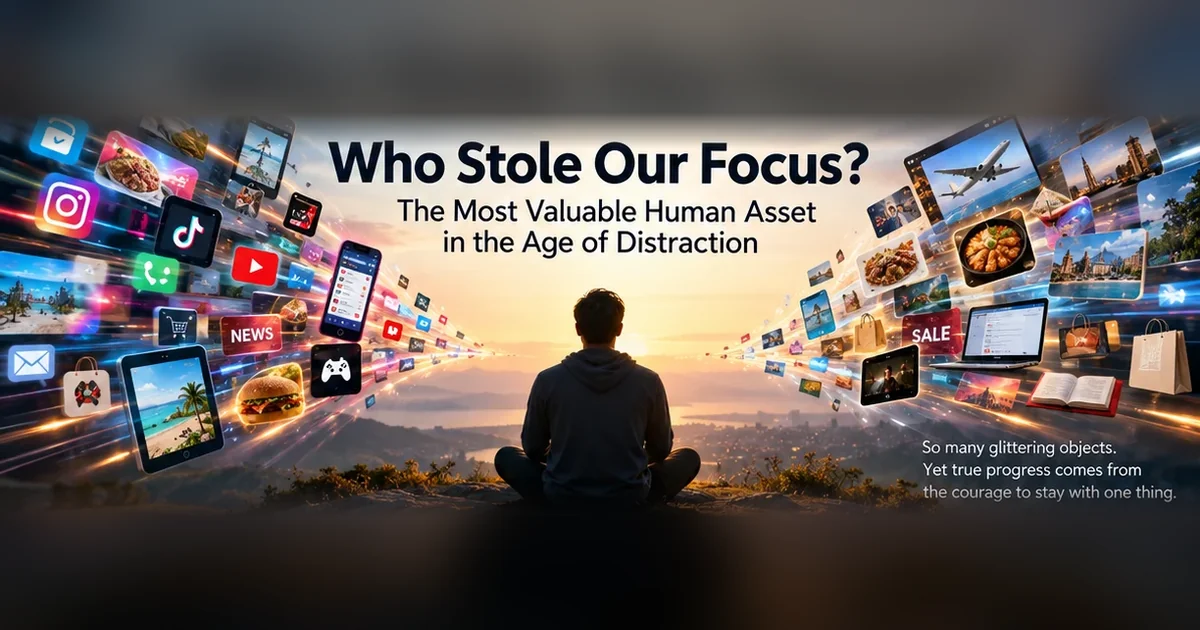
I have been thinking a lot about two words lately: focus and concentration.
Perhaps they have always been important. But I believe they are becoming even more valuable today—and will become increasingly important in the years ahead.
Why?
Because we are living in a world full of glittering objects competing for our attention.
Technology. Entertainment. Food. Shopping. Travel. Gadgets. Notifications. And, perhaps most significantly, social networking.
Everywhere we look, something is trying to attract us.
And perhaps the biggest question we should ask ourselves is:
Who stole our focus?
Our mind is naturally attracted to what we don't have
There is something interesting about human psychology.
We are often attracted to what is new, different, unavailable or just beyond our reach. Our mind constantly searches for the next thing.
What else is there?
What am I missing?
What is happening somewhere else?
What could I have instead of what I have right now?
This mechanism may have helped us survive and evolve. But in today's world, it is being amplified by technology.
We don't even have to search anymore.
The next distraction comes looking for us.
- A notification appears on our phone.
- A message arrives.
- A new video is recommended.
- Someone posts something.
- A headline flashes across the screen.
And suddenly, the thing we were doing five minutes ago no longer feels interesting.
We move on.
We don't realize when we lose our focus
Think about studying.
You start reading something interesting. You read a few pages. Then your mind starts wandering.
- Perhaps you check your phone.
- Maybe you open another tab.
- You see a notification.
- You respond to a message.
And then you return to the book.
But the concentration is gone.
The same thing happens at work.
"Focus on your work."
We hear it from our managers.
We tell it to ourselves.
We tell our children to focus on their studies.
Everybody knows that focus is important.
Yet somehow, someone has stolen our focus.
And the strange part is that we often don't notice it happening.
Distraction is becoming a habit
The problem isn't one notification.
The problem isn't one social media post.
The problem is the repetition.
A small distraction, repeated hundreds of times, can eventually become a habit.
Our mind starts becoming comfortable with constantly switching.
One subject.
Then another.
Then another.
We begin to feel uncomfortable when something doesn't provide immediate stimulation.
And that, in my opinion, is where the real problem begins.
We are not necessarily losing our ability to work.
We are losing our ability to stay with something.
And staying with something is where meaningful work, learning and understanding often begin.
Focus is easy to lose. Regaining it is different.
There is an interesting asymmetry here.
We can lose our focus almost instantly.
But getting it back requires deliberate effort.
When we lose our focus, we usually lose it while doing something attractive.
- Something entertaining.
- Something new.
- Something that gives us an immediate reward.
We don't feel like we are losing anything.
But when we try to regain our focus, we have to deliberately steer our mind away from all those attractive alternatives.
We have to tell ourselves:
Not this. Not now. Stay here.
That takes effort.
And the longer we have allowed ourselves to be distracted, the harder it can become to rebuild the habit of concentration.
But I don't think it is impossible.
Because if focus is a human capability, it is also something we can practice.
The power of concentration
I often think about a candle when I think about concentration.
A candle produces light.
But imagine trying to read a book beside a candle whose flame is constantly being pushed from one direction to another by the wind.
The flame is still there.
The energy is still there.
But the light isn't being directed effectively.
Now imagine the same candle in a completely still environment.
The flame becomes steady.
The light becomes predictable.
You can actually use it to illuminate something.
I think our minds work in a similar way.
Concentration is the ability to direct our mental energy towards a specific point.
When that energy is constantly being disturbed, our effort becomes scattered.
When it is concentrated, something interesting happens.
The same amount of energy can produce a much greater result.
That is the power of concentration.
Focus matters everywhere
This isn't only about productivity.
- Focus matters when we study.
- It matters when we learn something new.
- It matters when we work.
- It matters when we build something.
- It matters when we listen to another person.
- It matters in our relationships.
- It matters when we spend time with our children.
- It matters when we try to understand ourselves.
Almost everything meaningful requires some ability to stay present.
And perhaps that is why I increasingly see focus and concentration as fundamental human assets.
Not technical skills.
Not another productivity hack.
Not another app.
But the ability to decide:
This is what matters right now, and I am going to stay with it.
Perhaps multitasking isn't the superpower we think it is
This may sound contradictory in a world that celebrates multitasking.
- We are proud of answering emails while attending meetings.
- We switch between applications.
- We take calls while checking messages.
- We try to do five things simultaneously.
We often describe this as being productive.
But I have started questioning whether multitasking is really the skill we should be trying to improve.
Perhaps the more valuable skill is the opposite:
The ability to give one thing our full attention.
Because every time we switch, a little bit of our mental energy moves with us.
We may be doing more things.
But are we actually producing better outcomes?
I am not convinced.
Perhaps instead of becoming better at multitasking, we should become better at deep focusing.
We need to reclaim our attention
I don't have a magic formula for this.
There are plenty of techniques, systems and productivity methods that can help. But that isn't what I want to discuss here.
My thought is simpler.
We should first recognize that our attention is being competed for constantly.
And once we recognize that, protecting our attention becomes a conscious choice.
Because our attention is finite.
Where we put our attention is where we put our energy.
And where we repeatedly put our energy is ultimately where our life moves.
So perhaps the real question isn't:
"How can I do more things?"
Maybe the better question is:
"What deserves my attention right now?"
And once we have answered that question, perhaps the next challenge is even harder:
"Can we stay there?"
In a world where almost everything is trying to pull us somewhere else, the ability to stay focused may become one of the most valuable human capabilities we have.
Perhaps focus isn't something we need to find.
Perhaps it is something we need to reclaim.